Harmonicon: a rhythm game you play on a real harmonica
For once, something on this blog that isn’t C++.
Harmonicon is a rhythm game for blues harmonica. Notes scroll toward a hit line and you play on an actual harmonica, into your microphone, and the game listens.
The idea
The harmonica is cheap, fits in a pocket, and it hides everything: the reeds are inside, your tongue and throat do most of the work, and nothing about the instrument tells you whether the note that just came out is the note you meant. You can practise a bend wrong for a month quite happily.
Let the instrument be the input. Harmonicon captures the microphone, runs pitch detection on it in real time, and scores what you actually played against the chart. Every note you score is a note you genuinely hit.
Playing a song
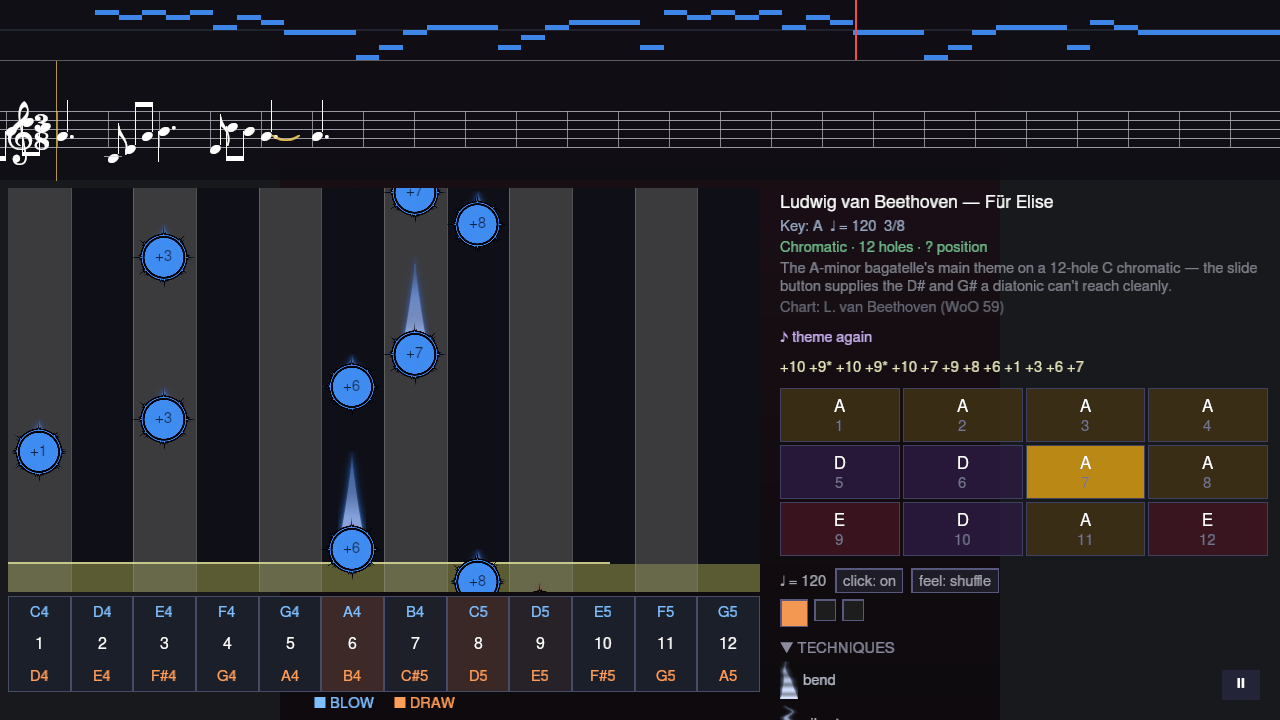
The default view is one lane per hole: ten for a diatonic, twelve for a chromatic, taken from whatever the chart was written for. Blue notes are blows, orange are draws, and the number on each is the hole you need. Above the lanes there’s the phrase in standard notation and as harmonica tab, because those are the two ways harmonica players actually read music, and the panel on the right tells you which harp to pick up and which position you’re playing in.
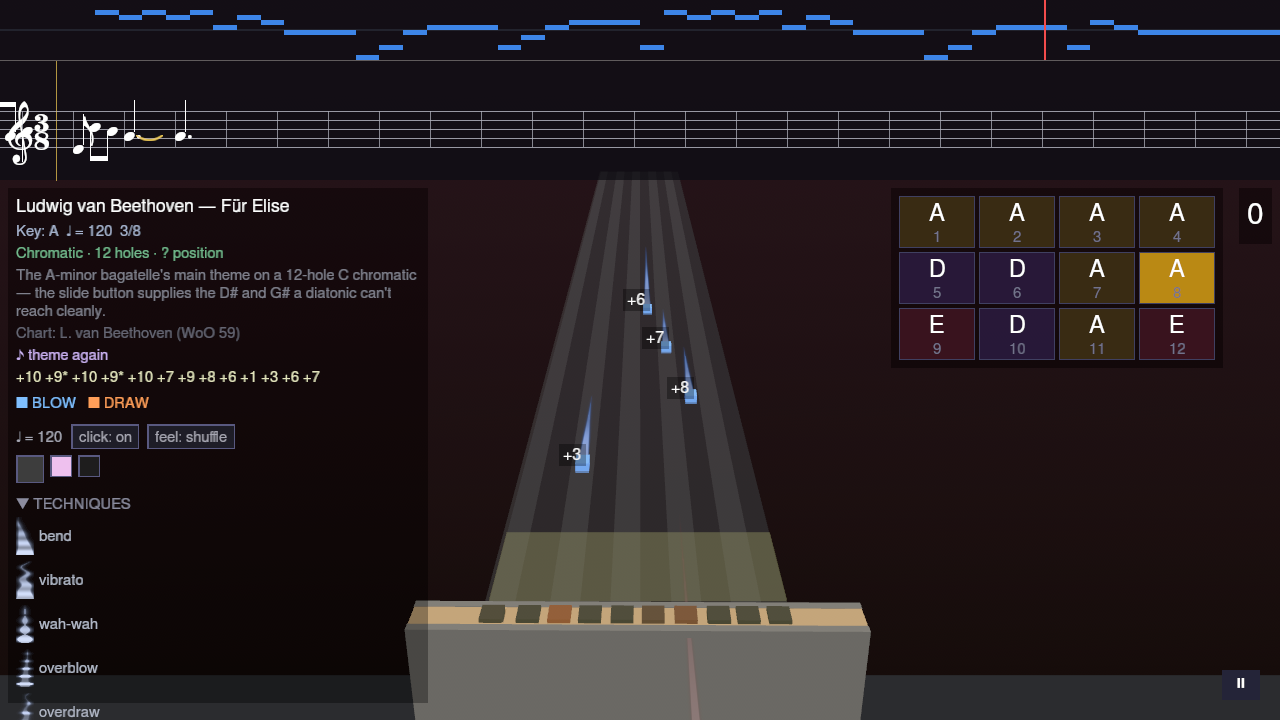
There’s also a 3D view, which is the same game rendered around a harmonica model that moves with the beat.
Getting away from charts
Charts are good for learning a song and bad for learning to play. The Jam Session mode drops the scoring entirely and gives you a rolling 12-bar blues to improvise over.
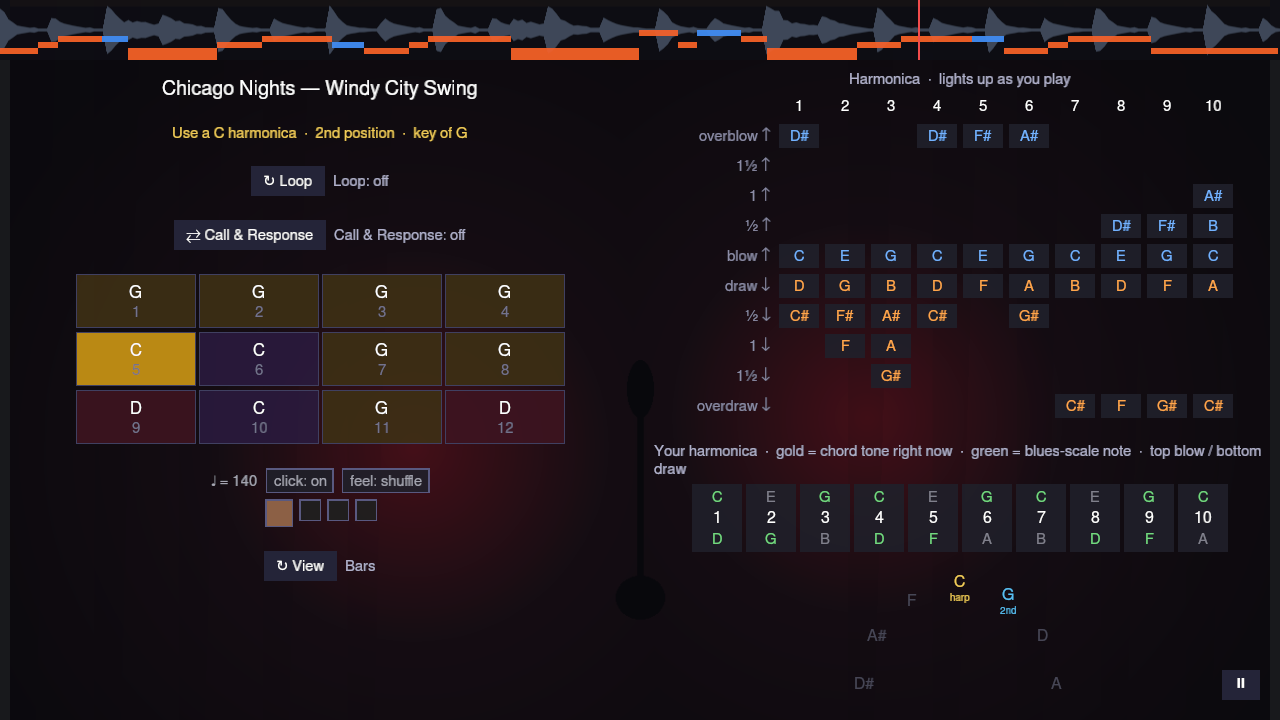
The useful part is the hole map on the right. As the backing moves through the bars, each hole recolours: gold if it’s a chord tone of the bar sounding right now, green if it’s elsewhere in the blues scale, dim if it’s going to sound wrong. You follow the colour instead of trying to recall theory at tempo, and the theory arrives later, on its own.
Lessons
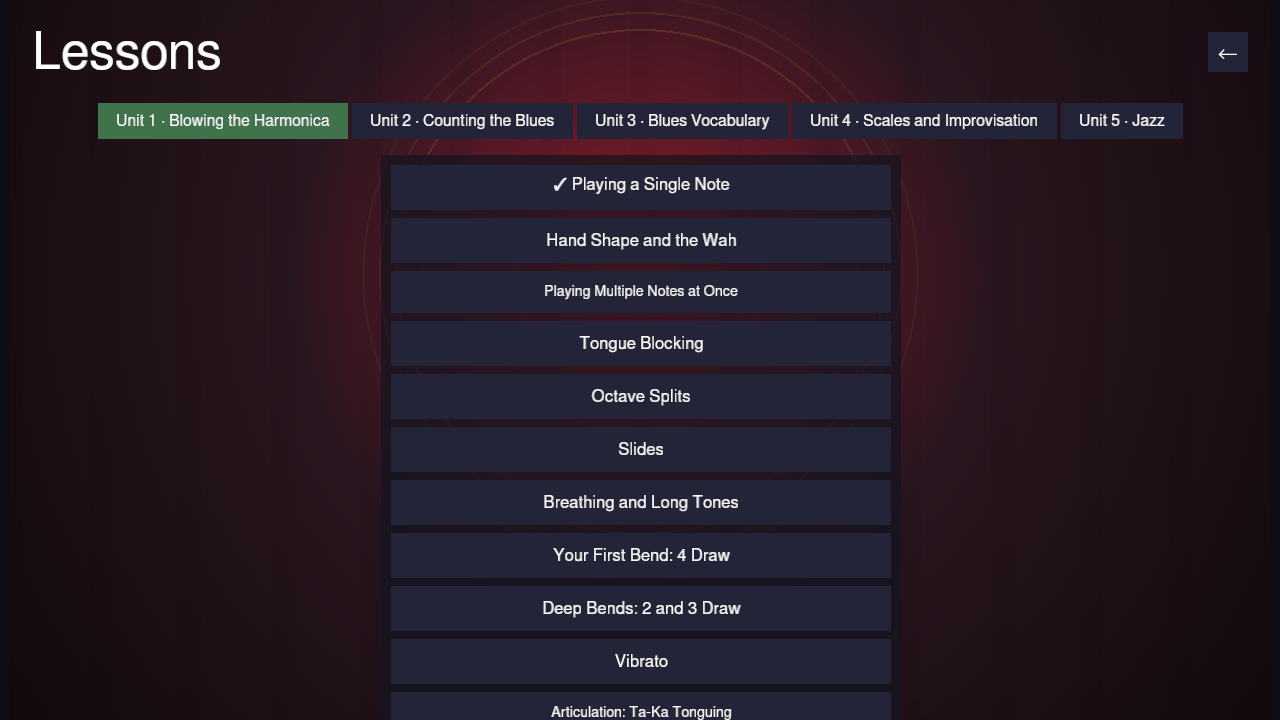
There’s a curriculum underneath all of this, grouped into units and gated by prerequisites, from getting one clean single note out of the thing, through bends and articulation, up to improvising over a blues. Some lessons are scored drills. A few aren’t scoreable at all: tongue blocking sounds identical to puckering from the microphone’s point of view, so that one is instruction you mark as done and the game trusts you.
Under the hood
Rust, with Bevy for the engine and cpal for audio
capture. The interesting problem is the pitch detection, which is why there are
five algorithms to chose from: FFT, YIN, pYIN, MPM and NMF.
Status
There’s a lot in it: a bending trainer, an in-game song editor with MIDI import, adaptive difficulty, A–B looping, latency calibration, a spectrogram, but “early/experimental” is an honest label rather than modesty.
It’s MIT licensed and the code is at github.com/tcanabrava/harmonicon. If you own a harmonica and a microphone, that’s the entire hardware requirement.